Recovered Carbon Black
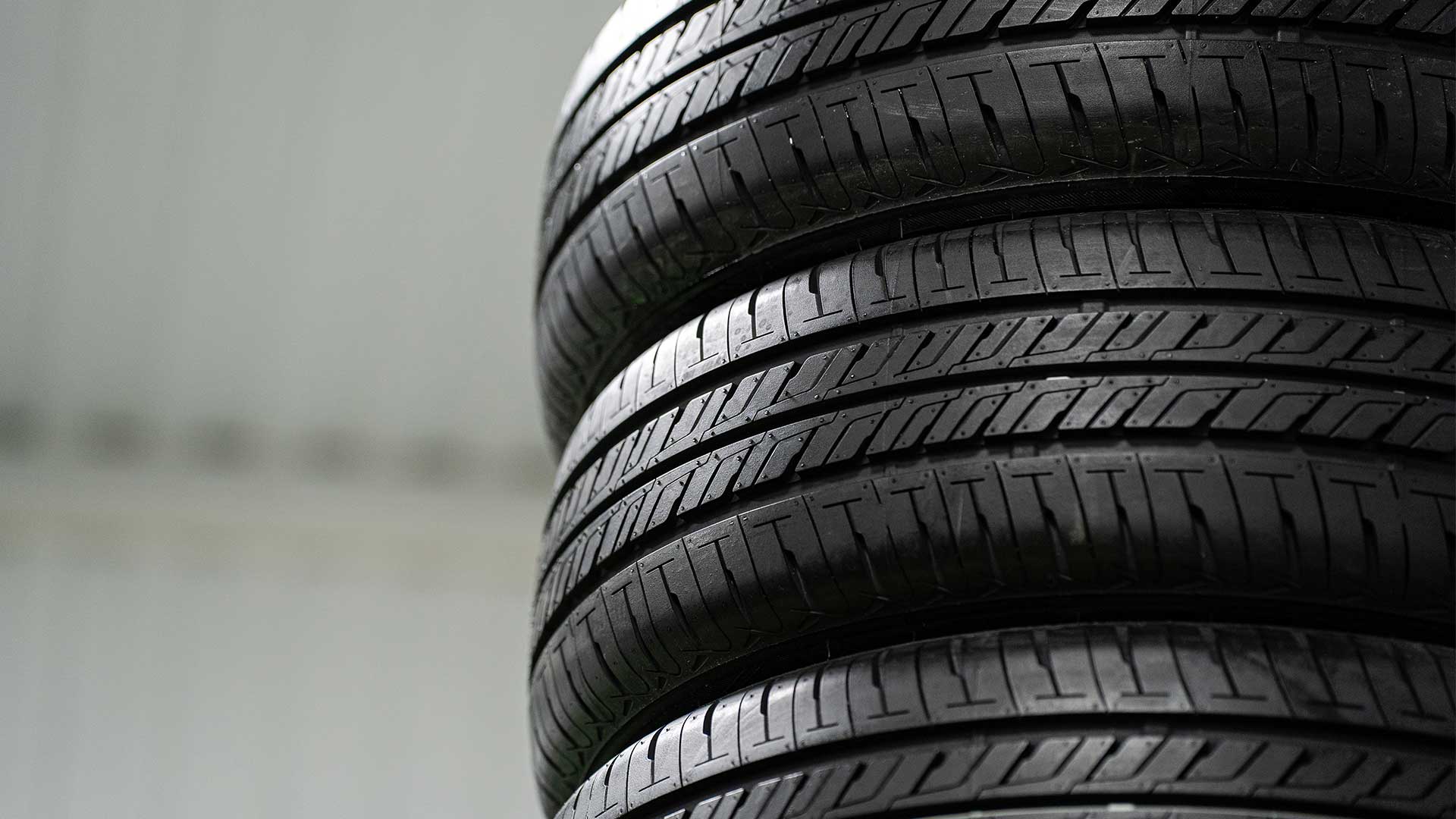

End-of-life tires are not only waste, but also a valuable source of raw materials. Through pyrolysis, part of the carbon they contain can be recovered as Recovered Carbon Black (rCB) and reused in industrial applications. New European rules on waste shipments can further increase the importance of suitable recovery routes within Europe. However, to turn a heterogeneous waste stream into a reliably usable secondary raw material, its composition and quality must be well understood. Elemental analysis provides important information for this purpose. Sources: [1-4]
Carbon Black - a valuable raw material of fossil origin
Carbon Black is an important component of numerous technical products. One of its most significant applications is in the tire and rubber industry, where Carbon Black serves as a filler and reinforcing material and influences key properties of the elastomer. Conventional Carbon Black is predominantly produced from fossil hydrocarbons. Consequently, Carbon Black production is associated with high CO2 emissions. [5,7]
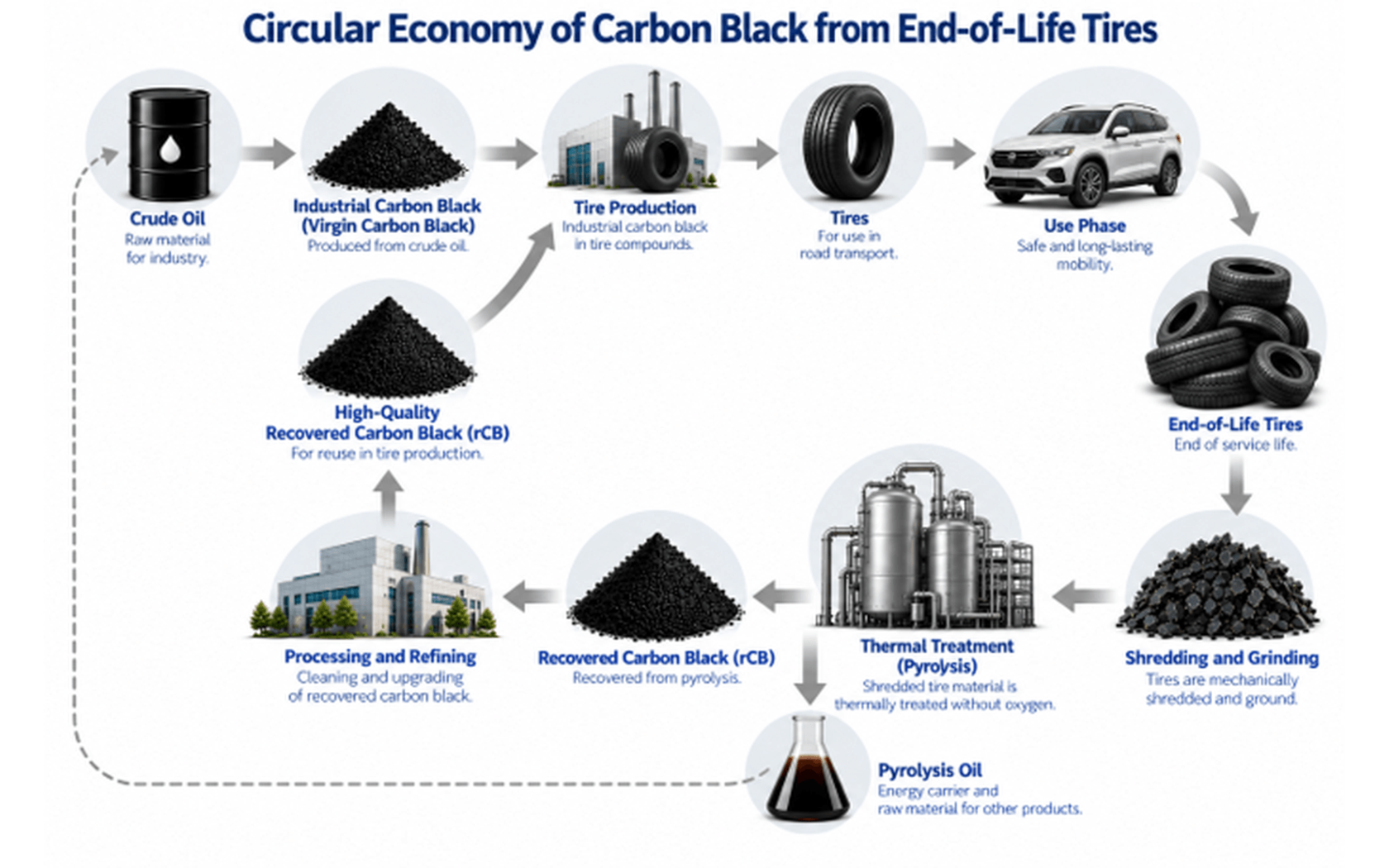
At the end of a tire’s service life, a substantial share of this carbon-rich material remains bound within the product. This raises an obvious question: Can the carbon it contains be recovered and reused as a raw material? This is where Recovered Carbon Black comes into play. [5]
From end-of-life tires to Recovered Carbon Black
One possible route for recovering value from end-of-life tires is pyrolysis. In this process, shredded tire material is thermally decomposed largely in the absence of oxygen. The process typically produces a gas fraction, pyrolysis oil and a carbon-rich solid. This solid forms the starting material for Recovered Carbon Black. [5]
However, this material is not simply the original Carbon Black in an unchanged form. Tires are complex mixtures of rubbers, fillers and additives. In addition to the original Carbon Black, the solid pyrolysis residue therefore contains other carbonaceous residues and inorganic constituents. For example, rCB can have a higher ash content than Virgin Carbon Black, and its properties also depend on the feedstock and the pyrolysis conditions. [5,7]
Downstream processing steps can convert the pyrolysis residue into a material that can once again be used as a filler. Scientific studies show that rCB can partially or completely replace conventional Carbon Black in elastomer formulations, although differences in processing behavior and material properties may occur depending on rCB quality. [6,7]
Why end-of-life tire recycling is becoming increasingly important
The regulatory framework is making this topic increasingly relevant. The European Waste Framework Directive establishes a five-step waste hierarchy: prevention, preparing for reuse, recycling, other recovery - for example energy recovery - and, finally, disposal. Recycling therefore generally takes precedence over energy recovery. [1]
Regulation (EU) 2024/1157 on shipments of waste adds further relevance. It has generally applied since 21 May 2026, although different application dates apply to certain provisions. In particular, Article 40, which concerns exports of certain non-hazardous waste to countries to which the OECD Decision does not apply, is applicable from 21 May 2027. [2]
This makes the conditions for waste exports to third countries more stringent. For the European circular economy, it is therefore plausible that certain waste streams that have previously been exported will increasingly be recovered within Europe in the future. [2]
This connection is particularly relevant for end-of-life tires: if more material streams remain within Europe, the need for efficient, high-quality recovery routes increases. Pyrolysis can play a role here because it generates several potentially usable material streams from end-of-life tires - including Recovered Carbon Black. [5]
AI generated
The challenge: not all rCB is the same
With conventional Carbon Black, production conditions can be specifically controlled to achieve defined properties. Recovered Carbon Black, by contrast, reflects both the history of its feedstock and that of the recycling process. Different tire types and formulations, as well as pyrolysis process parameters, can influence the properties of the recovered material. [5]
The quality of an rCB therefore cannot be described by a single parameter. Current studies investigate factors including elemental composition, ash content, volatile matter, surface area, structure and particle properties. For practical use as a filler, processing behavior and the mechanical properties of the elastomer compounds must also be evaluated. [5-7]
Knowing what has been recovered
Quantitative elemental analysis is an important part of this characterization. Determining carbon (C), hydrogen (H), nitrogen (N) and sulfur (S) provides information about the chemical composition of feedstocks and recovered Carbon Blacks. [5-7]
Carbon content is a key parameter for carbon-rich materials. At the same time, sulfur content is particularly relevant for tires and their pyrolysis products because sulfur is a component of vulcanization systems and can be distributed among different product streams during thermal treatment. Research on end-of-life tire pyrolysis therefore also addresses sulfur-containing compounds and desulfurization. [5]
Several studies demonstrate the use of elemental analysis in current rCB research. In their work on the production and characterization of rCB from end-of-life tires, Bogdahn et al. determined C, H, N and S contents using an Elementar vario MACRO cube. The same methodology was used in a follow-up study investigating the use of these rCB materials in elastomer products. [5,6]
Spanheimer et al. also used quantitative CHNS analysis with an Elementar vario MACRO cube in a comparison of Recovered, Sustainable and Virgin Carbon Black. At the same time, the study shows that accompanying constituents present in rCB can influence the crosslinking structure and reinforcing effect of EPDM compounds. [7]
This makes one point clear: elemental analysis is not an isolated product parameter, but part of a broader analytical picture. It helps characterize material batches, reveal differences between virgin and recycled materials, and track changes resulting from process and downstream treatment steps. [5-7]
A more circular economy requires greater knowledge of materials
Recovered Carbon Black illustrates the challenge behind a functioning circular economy. Technical recovery is only the first step. A heterogeneous waste stream must be transformed into a characterized secondary raw material that is suitable for specific applications. [3,5]
Regulatory developments make this task even more relevant: the European waste hierarchy prioritizes recycling over other forms of recovery, while the new EU Waste Shipment Regulation changes the framework for cross-border waste streams. As a result, high-quality recovery routes within Europe may become increasingly important. [1,2]
For end-of-life tires, pyrolysis offers the possibility of making the resources they contain available in new material streams. With Recovered Carbon Black, recycling technology, materials science and analytical chemistry intersect directly. Reliable analytical data provide the basis for objectively assessing the quality of the recovered material and investigating its suitability for reuse. [5-7]
The key question for a circular raw-material economy is therefore not only: What can we recover from waste? But also: How can we demonstrate that it has once again become a reliably usable material?
Sources and further reading
[1] European Parliament and Council of the European Union. Directive 2008/98/EC of 19 November 2008 on waste and repealing certain Directives, in particular Art. 4 (waste hierarchy). EUR-Lex. eur-lex.europa.eu/eli/dir/2008/98/oj
[2] European Parliament and Council of the European Union. Regulation (EU) 2024/1157 of 11 April 2024 on shipments of waste, in particular Art. 40 and Art. 86. EUR-Lex, current version. eur-lex.europa.eu/eli/reg/2024/1157/oj
[3] Federal Republic of Germany. Circular Economy Act (Kreislaufwirtschaftsgesetz - KrWG), Section 5 - End of waste status. Gesetze im Internet. www.gesetze-im-internet.de/krwg/__5.html
[4] European Commission. Waste shipments - information on the implementation of Regulation (EU) 2024/1157 and on cross-border shipments of waste. Directorate-General for Environment. environment.ec.europa.eu/topics/waste-and-recycling/waste-shipments_en
[5] Bogdahn, S.; Malek, C.; Koch, E.; Katrakova-Krüger, D. Production and Characterization of Recovered Carbon Black (rCB) by Waste Tire Pyrolysis as a Potential Carbon Black (CB) Substitute. Advanced Materials & Sustainable Manufacturing 2025, 2(2), 10007. doi.org/10.70322/amsm.2025.10007
[6] Bogdahn, S.; Koch, E.; Katrakova-Krüger, D.; Malek, C. Application of recovered Carbon Black (rCB) by Waste Tire Pyrolysis as an Alternative Filler in Elastomer Products. Advanced Materials & Sustainable Manufacturing 2025, 2(2), 10008. doi.org/10.70322/amsm.2025.10008
[7] Spanheimer, V.; Šimić, D.; Katrakova-Krüger, D.; Giese, U. Thermo-Oxidative Aging and Performance Comparison of Recovered, Sustainable, and Virgin Carbon Black in Ethylene Propylene Diene Monomer-Based Elastomers. Macromolecular Materials and Engineering 2025, 310(8), 2500034. doi.org/10.1002/mame.202500034
Note: Legal status as of September 2026. Statements on the potential impact of the EU Waste Shipment Regulation on the volume of end-of-life tires are presented as a regulatory assessment; no specific volume forecast is claimed.
Do not miss any new articles
NEWSLETTER
We will constantly publish new blog articles. Register for our newsletter to stay up-to-date and get informed about latest blog articles, news and trends.